Showing posts with label Ars litterae. Show all posts

Tuesday, August 21, 2007

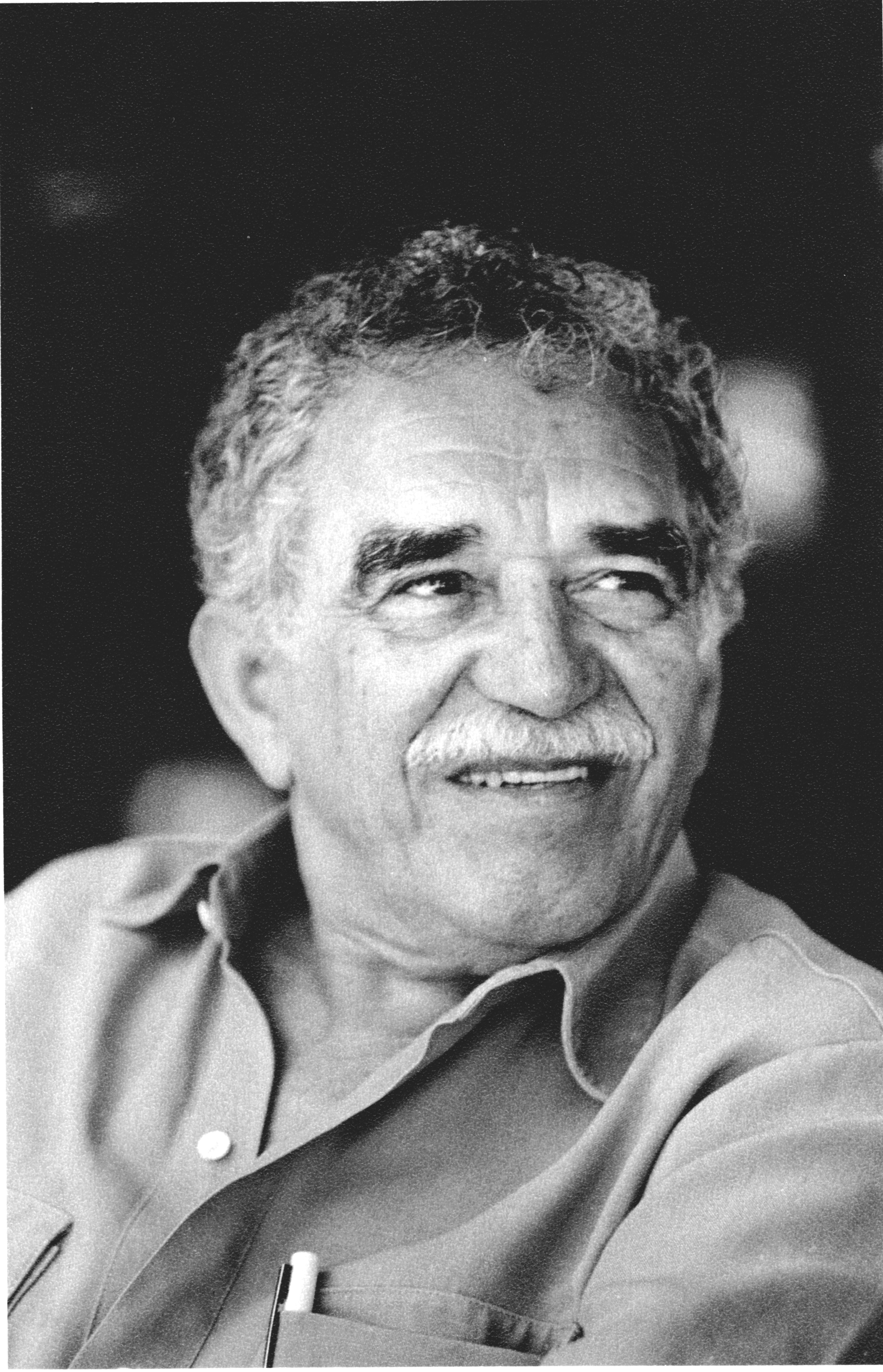
a "Salud!" to Gabriel Garcia Marquez for resurrecting your spirit


Not long ago I discovered that my leisure readings are deeply connected to Gabriel Garcia Marquez. I search for any novel that I can find and I am eager to discover a totally different world from the one described in his other writings. The Columbian author lets go of all his "demons" and proudly exploits his latin roots in creating incredible works, books that take the reader into a passionate Universe, dispared from reality, stories that happen in times controlled by human senses, love, divinity and ancient traditions and superstitions. His characters seem to follow the path which it was written for them, never in contradiction with their South American background. The Nobel prize winner succeeds to bring his readers into surreal worlds, that have a positive effect on their psychic. When reading Marquez is like a trip to the Caribbean, as I like to say. Along with his stories, he brings a flow of "corazon caliente", "una vida llena de passion".

I recommend his lecture begins with his autobiography, "Living to tell the tale", for an introduction in his world. Then, the paramount "One hundred years of solitude" is a must-read. Though you may not identify any element of your daily life in it, Macondo will grow as an ideal place to live. By approaching the same style in different stories, Marquez gets to be true nutrition for your spirit. A brilliant storyteller will reveal to you, allowing you to take a bite of every piece of South America: traditions, names, fiestas... a warm lifestyle. A man born with such a prodigious talent: telling tales.

For more elaborate informations, consult http://www.themodernword.com/gabo/

Wednesday, August 8, 2007

How to understand a text

In the last blog I posted some useful literature reading skills. In this article I want to share techniques that will help students, professionals or anyone trying to understand a certain text that reveals knowledge for their study.


SKIMMING
If you are reading to get a general impression, you should use a skill called skimming. When looking at a book, this will involve looking at the cover, title and contents page, chapter headings, sub-headings, the first and last sentence or paragraph within the chapters.

SCANNING
To search for the answer to a particular question, try scanning. This is the skill you use when finding names in the phone book – let your eyes scan down the page till you see the information you want.
Skimming and scanning are speedy and efficient techniques for getting what you need out of books and articles. Many students think it is cheating not to read every word in a book. Not so. You are cheating yourself when you waste time reading material not essential to your purpose.

READING FOR A DETAILED UNDERSTANDING - USE SQ3R

For a detailed understanding you might like to try the SQ3R method. Here’s how it works:

Step 1. SURVEY Look over the whole text. Check out the headings and the way it has been set out.

Step 2. QUESTION Ask yourself some questions about the text. Why am I reading this text?
What do I need to find out from this text? Does it look useful for my assignment?

Step 3. READ the text. Take some notes while reading. Sometimes this helps to keep you mind on the content.

Step 4. RECITE Stop every now and then and try to put into your own words what you have just read.

Step 5. REVIEW After you have finished look back over your notes and see if you can recall the main the points.

Source:
http://www.ncistudent.net/StudySkills/LearningSkills/ReadingEffect1.htm

Friday, August 3, 2007


The Romanian critic George Calinescu said in one of his writings that nowadays it gets harder for people to read efficientily, if not to read at all; they have lost the essence of true reading and the pleasure of understanding the book. When do we have time to read, anyway? When do we have that amount of time for ourselves when our life seems to be passing at high speeds. The truth is we barely find moments for literature. What about understanding it? Check out below if you want to read effectively. Don't let those pages be blank.


The way you approach reading a novel is very important. While reading you must be able to see relationships, perceive the development of character, theme, symbols, and be able to detect multiple meanings. You can reject or accept, like or dislike the literary work, depending on the effect it has on you. It is okay to do so. You shouldn’t jump to a final judgment too soon, whether it is about the character, the theme, or other elements. Remember: People and situations are not always as they appear at first. Be objective because your emotional reaction can sometimes cause unsound perception and interpretation. Keep this question in mind — “Can I justify my judgments based on evidence from the work itself?” To get the most out of literature, you must be aware of several elements in fiction and know how to make inferences. Below are a few guidelines to help you understand..
Characters — people and animals in a story. Examine each character for his or her own unique qualities, behavior, needs, and values.

Setting — the time and place of a story. What impact does it have on the plot of the story?

Plot — the series of events that happen in the story. Make sure you understand the most important events.

Theme — the idea or point of view expressed throughout. It unifies the work.

Conflict — the main struggle between opposing forces. The conflict can be (1) internal, i.e. within a character; (2) between two or more characters, or (3) between one or more characters and some force in the environment.

Climax — the final turning point in the story when the action changes course and begins to resolve itself. Sometimes the character may solve the problem in his or her mind.

Narrator — the person telling the story. Be alert to the tone of the narrator and how it influences your perception of the story.

Figures of Speech — expressions in which words are used to mean something other than what they usually do. For example, “Life is like a broken-winged bird that cannot fly.” This is a line from the Langston Hughes poem entitled “Dreams.” What is he trying to say about life?Inferences — to read “between the lines.” An inference is a message that comes across but is not directly stated by the author. You must draw conclusions based on the information given.


Writers of fiction often show what they mean while writers of non-fiction directly state what they mean.


As you read the novel and ultimately complete it, go back and review the elements listed. See if you can identify each element by citing specifics from the novel. Write down that information. Sit back and relax in a comfortable reading chair and have adequate lighting nearby. Make sure you are in a room without distractions for at least 30 minutes.